Foundation for Orthodontic Aligners Pakistan (FOAP)
New Press Release: Clear aligner therapy represents one of the fastest-growing segments in dental practice revenue >

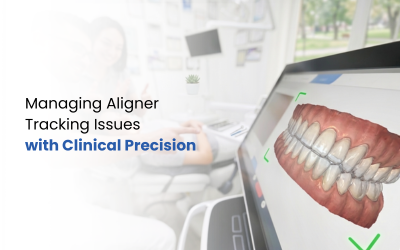
Managing Aligner Tracking Issues
with Clinical Precision
Get started
Mid-Course Correction: How We Fixed a Aligner Tracking Issue
Clear aligner therapy has significantly improved the way orthodontists diagnose, plan and deliver treatment. Through digital treatment planning, clinicians can visualize tooth movement and design highly customized treatment sequences before active therapy begins. Despite these advancements, treatment outcomes are not always fully predictable. Biological variability, patient compliance, attachment performance and complex tooth movements can all influence treatment progression. One of the most common challenges encountered during clear aligner treatment is a tracking issue, where teeth fail to follow the planned movement pathway. When detected early, these discrepancies can often be corrected without compromising treatment outcomes.
What Is an Aligner Tracking Issue?
An aligner tracking issue occurs when the actual position of the teeth differs from the position anticipated in the digital treatment setup. Can prevent the aligner from fitting properly against the teeth. As treatment progresses, this discrepancy becomes more apparent and may compromise the effectiveness of subsequent aligners.
In clear aligner therapy, each aligner delivers carefully programmed forces intended to produce controlled tooth movement. When these forces are not expressed correctly, the relationship between the aligner and the dentition changes, resulting in poor aligner adaptation. Clinically, this appears as gaps between the aligner and tooth surfaces, incomplete attachment engagement, or delayed treatment progress. If left unmanaged, tracking issues may reduce treatment efficiency and affect the final outcome.
Read More: Why Dentists in Pakistan Prefer Aligner Therapy
Why Clear Aligners Stop Tracking During Treatment
Tracking failure rarely results from a single factor. In most cases, multiple biological and mechanical variables contribute to the problem. While digital treatment planning provides a roadmap for movement, actual tooth response depends on the patient’s biology and adherence to prescribed instructions.
One of the most frequent causes is inconsistent aligner wear. Patients who do not meet the recommended daily wear time often experience incomplete tooth movement before advancing to the next aligner. Similarly, if an attachment loses grip, the aligner may not apply the planned force effectively, making movements such as tooth rotation, extrusion and root control more difficult to achieve.
Treatment complexity also plays a role. Certain tooth movements are inherently less predictable and may not respond exactly as simulated. Rotations of rounded teeth, extrusion of incisors and significant root torque movements frequently require closer monitoring and occasional refinement during treatment.
Common Signs of Aligner Tracking Failure
The clinical presentation of tracking issues can vary depending on the severity and location of the discrepancy. However, several signs consistently indicate that tooth movement is no longer following the planned pathway. The most common finding is the appearance of visible gaps between the aligner and the incisal edges of teeth. In some cases, clinicians may observe incomplete seating around posterior teeth, reduced attachment engagement, or unexpected occlusal changes.
Patients may also notice that new aligners feel unusually tight, are difficult to insert, or tend to lift away from the teeth during wear. These symptoms often indicate that movement from the previous stage was not completed successfully. Early recognition of these signs is essential because minor discrepancies are considerably easier to correct than advanced tracking failures.
How to Identify Tracking Problems Early
Early diagnosis is one of the most important aspects of successful aligner treatment management. Waiting until a significant discrepancy develops often increases treatment complexity and may require extensive refinements.
At every review appointment, clinicians should assess aligner fit objectively alongside the patient’s reported experience. Examination should include evaluation of attachment engagement, aligner adaptation, tooth position and occlusal relationships. Comparing current clinical findings with the original treatment objectives provides valuable insight into treatment progression.
Digital scanning technology has become particularly valuable for early diagnosis. By comparing updated scans with the original digital setup, clinicians can identify small deviations before they become clinically significant. This proactive approach improves treatment predictability and minimizes unnecessary delays.
Mid-Course Correction in Clear Aligner Therapy
A mid-course correction is a planned clinical intervention performed when treatment progression no longer matches the original digital setup. Rather than continuing with clear aligners that no longer fit accurately, clinicians reassess the case and implement modifications designed to restore treatment control.
The objective of a mid-course correction is not merely to address the immediate discrepancy. Instead, it aims to re-establish biomechanical efficiency for the remainder of treatment. Depending on the severity of the problem, correction may involve revised wear protocols, attachment modifications, additional interproximal reduction, updated digital records, or a completely new aligner sequence.
Why Teeth Sometimes Fail to Follow the Digital Plan
Although digital orthodontics has improved treatment planning dramatically, tooth movement remains a biological process influenced by numerous variables that cannot be predicted with absolute certainty.
Bone density, periodontal ligament response, root morphology and age-related factors all influence movement efficiency. Two patients with nearly identical treatment plans may respond differently because of variations in biological remodeling capacity.
Furthermore, some movements require a high degree of force control. Rotational correction, extrusion and root torque often challenge aligner systems more than simple tipping movements. Even with optimized biomechanics, minor discrepancies may occur and require clinical intervention.
Understanding these limitations allows orthodontists to set realistic expectations and respond effectively when treatment deviates from the original plan.
The Role of Attachments in Aligner Tracking
Attachments are among the most important components of modern aligner biomechanics. These composite auxiliaries enhance retention and enable the aligner to deliver forces that would otherwise be difficult to achieve.
Without proper attachment engagement, many programmed tooth movements become less predictable. Rotational control, extrusion mechanics and root positioning depend heavily on attachment effectiveness. Consequently, attachment failure is a common contributor to tracking problems.
During treatment reviews, clinicians should routinely verify that all attachments remain intact and fully engaged within the aligner. Even a single missing attachment can significantly influence force delivery and treatment progression.
How Patient Compliance Affects Treatment Progress
Patient compliance remains one of the strongest predictors of treatment success in clear aligner therapy. Unlike fixed appliances, aligners depend entirely on patient cooperation to maintain consistent force application.
When aligners are removed frequently or worn for insufficient hours each day, teeth may not complete the programmed movement before the patient advances to the next aligner. Over time, these small discrepancies accumulate and eventually manifest as tracking problems.
Effective patient education should begin before treatment starts. Patients who understand the relationship between aligner wear and treatment outcomes are more likely to comply with instructions and achieve predictable results.
How We Diagnosed the Tracking Issue
In this case, routine treatment monitoring revealed early signs of a developing tracking problem. A slight gap was observed between the aligner and the maxillary anterior teeth. Although the discrepancy appeared minor initially, closer evaluation indicated incomplete rotational correction and reduced attachment engagement.
The patient reported generally good compliance; however, further discussion revealed occasional reductions in daily wear time during recent travel. Clinical examination also identified partial attachment loss that had gone unnoticed by the patient.
Digital comparison of current tooth positions with the original treatment setup confirmed that movement progression was lagging behind the prescribed staging sequence. Early diagnosis allowed intervention before more significant complications developed.
Read More: Retention After Aligner Therapy: Why Retainers Matter
Step-by-Step Management of an Aligner Tracking Problem
Management began with a comprehensive reassessment of the case. The first objective was to identify all contributing factors rather than focusing solely on the visible aligner discrepancy.
Lost attachments were replaced to restore biomechanical control. The patient received additional guidance regarding aligner wear, seating techniques and the importance of maintaining consistent treatment protocols. The current aligner was worn for an extended period to encourage completion of the intended movement.
Updated digital scans were then obtained to evaluate the remaining discrepancy accurately. Based on these records, a refinement sequence was developed that incorporated revised staging and optimized force delivery. This approach successfully re-established tracking and allowed treatment to progress according to revised objectives.
How New Scans Help Correct Tracking Issues
Updated digital records provide clinicians with an accurate representation of current tooth positions. Rather than relying solely on visual assessment, orthodontists can evaluate treatment progression objectively and identify specific areas where movement has deviated from the original plan.
These scans serve as the foundation for refinement planning. By incorporating current tooth positions into a revised treatment setup, clinicians can design aligners that address existing discrepancies and restore treatment predictability.
Modern scanning technologies have therefore become an essential component of effective aligner case management.
The Importance of Regular Orthodontic Reviews
Regular monitoring remains indispensable, even in highly digital treatment systems. Scheduled reviews provide opportunities to evaluate biomechanics, verify attachment integrity, assess oral health and identify emerging treatment problems.
Many tracking issues begin as small discrepancies that are barely noticeable to patients. Without professional evaluation, these problems may progress through multiple aligners before being detected. Consistent review protocols therefore play a critical role in maintaining treatment efficiency and achieving optimal outcomes.
Clinical Lessons from a Tracking Issue Case
This case highlights several important clinical principles. First, early detection remains the most effective strategy for managing tracking problems. Second, clinicians should never assume that reported compliance accurately reflects actual wear patterns. Third, attachment integrity must be verified at every appointment.
Perhaps most importantly, the case demonstrates that tracking issues do not necessarily indicate treatment failure. With appropriate diagnosis, updated records and carefully planned refinements, most discrepancies can be corrected successfully without restarting treatment.
Read More: How Clear Aligners Improve Patient Confidence and Compliance
FOAP Pakistan and Education in Digital Orthodontics
The Foundation for Orthodontic Aligners Pakistan (FOAP) continues to promote excellence in aligner therapy through education, professional development and evidence-based clinical training. As clear aligner treatment becomes increasingly popular across Pakistan, orthodontists must remain informed about evolving treatment protocols, digital workflows and complication management strategies.
Educational initiatives focused on biomechanics, treatment monitoring and aligner refinements help clinicians improve treatment predictability and deliver better patient outcomes. By sharing clinical experiences and encouraging continuous learning, FOAP supports the advancement of digital orthodontics throughout Pakistan.
End Note
Tracking issues are an expected clinical challenge within clear aligner therapy and Clinicians who approach tracking issues systematically, detecting them early, reassessing digitally and correcting with precision will find that they rarely derail a case that was well planned from the start. Successful outcomes depend on early diagnosis, systematic monitoring, accurate digital reassessment and timely intervention. Mid-course correction allows orthodontists to address discrepancies before they compromise treatment objectives, preserving both efficiency and predictability. As digital orthodontics continues to evolve, clinicians who combine advanced technology with sound biomechanical principles will be best positioned to manage complications and achieve consistently successful results.